
bobdule | 12 November 2026 | 14.16 MB
安装方法:
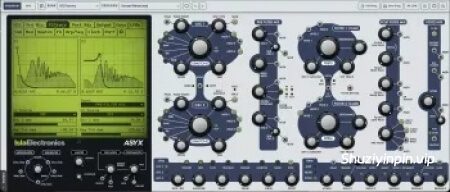
Andromeda A6,以插件形式重现。
软件重现了原乐器的架构和音色。
ASYX 内部
包含详细的信号路径,并提供相应的控制选项供您探索。您可以从简单的设置开始,然后根据音色需求深入探索。
01 / 振荡器
ASYX 模拟了 A6 定制振荡器 ASIC 的行为,其模拟设计源自 Moog 921B。每个复音配备两个振荡器,可提供同步波形、脉冲宽度控制、子振荡器、硬同步和软同步以及频率调制。噪声和环形调制信号输入到前置滤波器混音器。
02 / 双滤波器
ASYX 模拟了 A6 的滤波器 ASIC:一个源自 Oberheim SEM 的 12 dB/倍频程多模滤波器和一个源自 Moog 904A 的 24 dB/倍频程低通滤波器。提供低通、高通、带通和陷波响应,支持串联或并联路由以及独立的滤波器前和滤波器后混音。
03 / 低频振荡器 (LFO)
三个 LFO,每个 LFO 具有六种波形,并可独立调节速率、振幅、偏移、起始相位、占空比和极性。每个 LFO 均提供延迟、触发和时钟同步设置。
04 / 多级包络
三个七级包络:延迟、起音、两个衰减、延音和两个释放。每个起音、衰减和释放阶段均有九种可选曲线,并可调节中间电平。其他控制功能包括循环、触发和重触发源、力度响应、音符跟踪和平滑处理。
05 / 深度调制
调制路由具有独立的源、目标、调制量、偏移和启用控制。源包括包络、LFO、采样保持器、跟踪生成器、MIDI 和演奏控制器;目标包括包络阶段时间以及振荡器、滤波器和效果器参数。
06 / 音序器/琶音器
一个 16 步音序器,每个步进均可调节音符、力度、门限和休止符,以及一个带有独立网格和设置控制的琶音器。音序器和琶音器设置随每个程序保存。
07 / 效果器
29 种数字效果算法,包括合唱、延迟、混响和组合配置。算法参数和效果器设置随每个程序保存。
08 / 模拟特性
振荡器调谐、跟踪和脉冲宽度、滤波器截止频率和共振、包络时序、音色电平、共享漂移和振荡器漂移的独立变化深度。主模拟控制旋钮可调整组合变化。
09 / 混合模式
每个插件实例最多可包含 16 个声部,用于多音色操作、键盘分割和叠加。每个声部都有自己的程序、MIDI 通道、音域、电平和输出路由。
全面的音色管理。
内置超过 1200 个程序,包含原厂音色和艺术家音色库。可按名称、作者或音色库搜索,按类别筛选,并将收藏夹保存到常用位置。
您的音色,
可在两台乐器上使用。
A6 的旋钮和按钮支持双向 MIDI 连接,可控制 ASYX。启用实时参数发送功能,即可反向操作:在 ASYX 中所做的更改将发送到硬件。此功能适用于兼容的程序参数,因此您可以从任一界面进行编辑。
将 A6 的 SysEx 程序和音色库导入库中,或将当前程序(包括未保存的编辑)发送回选定的硬件插槽。您还可以传输音色库。音色和音色库传输与实时编辑相互独立,在覆盖硬件程序之前会要求您确认。
将大型音色库保存在 ASYX 中,并在需要传输到硬件时准备一个 A6 128 程序格式的音色库。ASYX 独有的功能(例如复音触后)仍然是软件功能。
史诗级灵感
Alesis Andromeda A6 将十六个模拟复音、双滤波器和丰富的调制功能融于一体。如今,能正常使用的 Andromeda A6 越来越难找,不断上涨的二手价格也让许多音乐人望而却步。
维护保养也变得越来越困难。Andromeda 依赖于定制的振荡器和滤波器芯片——ASIC(专用集成电路)——而许多设备由于无法找到替换零件而无法使用。
ASYX 的开发旨在让这款乐器以软件的形式重现。我们直接使用一台原版 A6,测量、比较并优化了它的性能,同时保留了与原版音色的兼容性。对于现有用户而言,ASYX 提供了一种使用原版音色的全新方式。对于其他用户而言,ASYX 则让他们无需承担老旧硬件的成本和维护费用,即可轻松使用 Andromeda 的音色。
ASYX 1.30.1 — 2026年11月11日
1.29.1版本更新– 为当前音色的最后100个编辑步骤添加了撤销和重做功能。加载另一个音色会重新开始编辑历史记录。
– 在弹出面板中新增了八个MIDI A-H宏旋钮,支持自定义名称和MIDI学习功能。(双击旋钮条上的宏名称即可重命名。)名称也会显示在LCD调制源列表中。
– 功能区和宏现在具有匹配的堆叠标签,可以同时打开。
– 改进了DAW自动化和控制器映射中的包络和LFO控制,包括音乐同步分割和包络循环选择。
– 移除了MIDI学习模式下的横幅。
– 修复了从早期版本恢复编辑时切换到混合模式失败并显示“无效的工作副本基线”错误的问题。
– 主速度旋钮现在可以显示和调整正在运行的本地琶音器的速度。时钟同步琶音器继续使用主速度;音色库的同步源选择保持不变。-
修复了因反复调整窗口大小而导致的 Windows 编辑器故障。
The Andromeda A6, recreated as a plugin.
The architecture and sounds of the original instrument, recreated in software.
Inside ASYX
A detailed signal path, with the controls to explore it. Start simply, then go as deep as the sound requires.
01 / Oscillators
ASYX models the behaviour of the A6’s custom oscillator ASICs, whose analogue design drew on the Moog 921B. Two oscillators per voice provide simultaneous waveforms, pulse-width control, sub-oscillators, hard and soft sync, and frequency modulation. Noise and ring modulation feed the pre-filter mixer.
02 / Dual filters
ASYX models the A6’s filter ASICs: an Oberheim SEM-derived 12 dB/octave multimode filter and a Moog 904A-derived 24 dB/octave low-pass filter. Low-pass, high-pass, band-pass and notch responses, with series or parallel routing and separate pre- and post-filter mixing.
03 / LFO
Three LFOs with six waveforms and individual rate, amplitude, offset, start phase, duty cycle and polarity controls. Delay, trigger and clock-sync settings are available for each LFO.
04 / Multi-stage Envelopes
Three seven-stage envelopes: delay, attack, two decays, sustain and two releases. Nine selectable curves for each attack, decay and release stage, with adjustable intermediate levels. Additional controls cover looping, trigger and retrigger sources, velocity response, key tracking and smoothing.
05 / Deep Modulation
Modulation routing with independent source, destination, amount, offset and enable controls. Sources include envelopes, LFOs, sample & hold, the tracking generator, MIDI and performance controllers; destinations include envelope stage times as well as oscillator, filter and effects parameters.
06 / Sequencer / Arpeggiator
A 16-step sequencer with per-step note, velocity, gate and rest controls, alongside an arpeggiator with its own grid and setup controls. Sequence and arpeggiator settings are stored with each program.
07 / Effects
29 digital effect algorithms, including chorus, delay, reverb and combined configurations. Algorithm parameters and effects settings are stored with each program.
08 / Analogue character
Independent variation depths for oscillator tuning, tracking and pulse width, filter cutoff and resonance, envelope timing, voice levels, shared drift and oscillator drift. The master Analogue control scales the combined variation.
09 / Mix mode
Up to 16 parts per plugin instance for multi-timbral operation, keyboard splits and layered stacks. Each part has its own program, MIDI channel, key range, level and output route.
Comprehensive Patch Management
More than 1,200 included programs, with original factory sounds and artist banks. Search by name, author or bank, filter by category, and keep favourites close at hand.
Your sounds.
Across both instruments.
With MIDI connected in both directions, the A6’s knobs and buttons can control ASYX. Enable live parameter sending to work the other way: changes made in ASYX are sent to the hardware. This works with compatible program parameters, so you can edit from either interface.
Import original A6 SysEx programs and banks into the library, or send the current program—including unsaved edits—back to a chosen hardware slot. You can also transfer a bank. Patch and bank transfers are separate from live editing and ask for confirmation before overwriting hardware programs.
Keep large banks in ASYX, and prepare a bank in the A6’s 128-program format when you need a hardware transfer. ASYX-only features such as polyphonic aftertouch remain software features.
Epic Inspiration
The Alesis Andromeda A6 combined sixteen analogue voices, dual filters and extensive modulation in one instrument. Today, working examples are becoming harder to find, and rising second-hand prices put ownership beyond the reach of many musicians.
Maintaining them is also becoming increasingly difficult. The Andromeda relies on custom oscillator and filter chips—ASICs (Application Specific Integrated Circuits)—and many units are now out of service because replacement parts cannot be sourced.
ASYX was developed to make this instrument accessible in software. Working directly with an original A6, we’ve measured, compared and refined its behaviour, while retaining compatibility with original patches. For existing owners, it offers another way to use their sounds. For everyone else, it provides access without the cost and maintenance of ageing hardware.
ASYX 1.30.1 — 11 November 2026
Changes since 1.29.1– Added Undo and Redo for the last 100 edit steps in the current sound. Loading another patch starts a new edit history.
– Added eight MIDI A–H macro knobs in a pop-out panel, with custom names and MIDI Learn. (Double-click a macro name on the knob strip to rename it.) Names also appear in the LCD modulation-source lists.
– Ribbon and Macros now have matching, stacked tabs and can be open together.
– Improved envelope and LFO controls in DAW automation and controller mappings, including musical sync divisions and envelope-loop choices.
– Removed the banner from MIDI Learn mode.
– Fixed switching to Mix mode failing with “Invalid working-copy baseline” when restoring edits from an earlier version.
– The main tempo knob now displays and adjusts a running LOCAL arpeggiator’s tempo. Clock-synced arps continue to use the master tempo; the patch’s sync-source choice is preserved.
– Fixed Windows editor failures caused by repeated window resizing.



评论0