
P2P | August 2026 | 185 / 313 MB
安装方法:
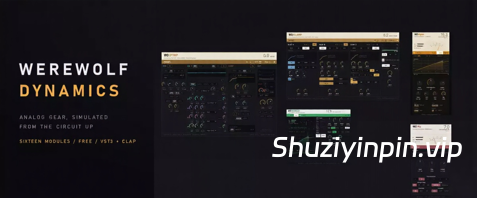
模拟设备,从电路层面进行模拟。二十二款插件,免费。
大多数“模拟建模”插件只是一个简单的快照:测量硬件,拟合一些曲线,然后发布这些曲线。而这些插件则在你的音频信号通过时,求解实际电路。当你猛烈敲击时,电子管偏置会发生改变。变压器铁芯会因磁通量而饱和,因此它不仅关注电平,还关注频率。光电管会记住你十秒前播放的内容。没有任何绘制过程;如果仪表指针移动或曲线弯曲,
则说明电路中的某个部分发生了变化。由于整个电路都包含在内,你甚至还能获得一把螺丝刀。每个模块都有一个后面板,上面有硬件内部的维护微调设置:电源电流、偏置、变压器动态余量、电子管更换。将它们设置为出厂设置,它就会像一台保养良好的设备一样运行。或者,你也可以不设置。
阵容
WD Opto ——LA-2A 血统的光管压缩器。光电管是真正的原汁原味:两个时间常数、程序相关的记忆功能,以及缓慢的衰减尾音。两种音色(电子管 WD-2A,固态 WD-3A),外加原版没有的驱动和铁芯控制。
WD Mu——基于模拟 6386 推挽级和经典六位时间常数库的可变 μ 压缩器。没有阈值旋钮,因为电路本身就没有;驱动它,它就会自动衰减。前面板上有偏置旋钮,后面板上有不匹配的电子管对。
WD Tec——无源电子管均衡器,在一个宽大的模块中集成了程序和中频部分。它拥有你绝对不会出错的增益,而且还有一点特别之处:滤波器电感器带有带电磁芯,一个“磁芯”旋钮可以调节你施加的磁芯强度。
WD Tape——一台完整的磁带机。录音磁头、偏置振荡器、回放磁头,所有部件都经过校准,校准过程与技术人员对硬件的校准流程相同。提供两种标准配置。每款产品都有其独特的运输特性。
WD XQ——一款参数均衡器,五种电路。它包含精准的数字电路、两种调音台风格、经典的美国阶梯式均衡器以及源自 1973 年的电感器设计。旋钮位置固定,而其下方的电路会改变旋钮的功能。所有五种均衡器均具备动态频段。
WD FET——一款 FET 压缩器,在一个机箱内集成了四种电路定律:常用的 76 定律、经过压缩的 760 定律、锗管定律以及纯净的精准定律。其压缩比网络基于 1176LN 的设计图,因此所有按钮都能正常工作,这得益于电路本身的强大功能,而非人为的曲线模拟。启动时间以微秒为单位。
WD VCA——一款基于 Blackmer 式增益单元的立体声总线压缩器。它拥有两个检测器:Console Bus 功能可以像著名的调音台压缩器一样对整个混音进行后倾处理,而 RMS Punch 功能则用于鼓组总线。它具备自动释放、过弯拐点等特性,并且 RMS 检测器的启动表由一个电容器控制,与硬件相同。
WD Duress——一款秉承 Distressor 精神的曲线系列压缩器。每个压缩比档位都对应着一条精心设计的曲线:1:1 是完全无压缩的暖音失真,10:1 借鉴了带有 20 秒尾音的光电释放,而 Nuke 则是对数释放的砖墙式压缩。它拥有三种失真模式、两种源自框图的立体声链接规则,以及一个英式模式开关,该开关会像滥用所有按钮一样覆盖包络。
WD Clamp——三个压缩器,一个电源。您可以将光电、μ、FET 或 VCA 引擎分别加载到三个插槽中,并以任意顺序串联它们,让它们像机架中的硬件一样共享一个电源轨。驱动一个插槽,相邻的插槽也会受到影响。传输屏幕显示的是测量曲线,而非图示,每个插槽的实时输入电平都对应着一个点。
WD Pre— 五个前置放大器位于一个增益旋钮之后。精密数字线材、一台带铁芯的A类英国调音台、一台美国运算放大器调音台、一台德国广播级电子管,以及一个四轨磁带调音台通道。增益旋钮重新分配电路,因此每个档位都对应一个略有不同的放大器;输出仅在铁芯之后通过一个推子实现。
WD Echo — 磁带循环回声,其循环效果足够逼真,可以进行拼接。电机驱动的传输装置,三个磁头,弹簧罐。重复速率由电机驱动,而非延迟旋钮:旋转它,循环中所有已在磁带上的音频都会随传输装置一起弯曲。时间箭头指示磁带正向、回文或完全反向播放。
WD AX — 激励器,基于专利技术而非围绕专利技术构建。它添加生成的边带,而不是提升均衡器,因此基频始终保持不变。“大低音”部分提升音符的衰减而非冲击:在不产生过载损失的情况下实现延音。
WD Rack — 机箱。把它放在主总线上,给模块分配相同的机架编号,它们就仿佛被装进了同一个盒子里:共享电源,相邻模块高负荷运行时电压会下降;相邻插槽之间会产生串扰;插槽映射可以重新排序。调高串扰,机架本身就成了一个效果器。完全忽略串扰,每个模块都能独立干净地运行。
WD Strip——一个窗口内的控制台通道:前置放大器→均衡器→压缩器,每个级都有型号选择器。可以选择五种前置放大器定律中的任何一种,均衡器中的任何一种,以及四种压缩器中的任何一种。所有三个级都使用同一电源轨供电,因此当前置放大器的电源负荷增加时,压缩器的拐点也会随之变化。面板上的响应曲线和压缩器传递函数都是从运行中的引擎实时测量得到的,而不是绘制出来的。无需机架。
WD Summer Channel——控制台通道,每个音轨一个。一个选择器上连接着五台调音台:一台是带有变压器低音的英式调音台,一台是大型的干净直列式调音台,一台是带有钢芯低音和硬朗快速转角的分立运算放大器调音台,一台是EF86电子管调音台,还有一台平时隐蔽,直到你用力按压才会显露的德国广播放大器。每台调音台都与其他调音台略有不同,与音轨名称相对应,就像1972年制造的四十个通道条彼此之间略有差异一样。
WD Summer——这些通道汇聚成的总线,它的行为也像一个总线。你加载到编组中的通道越多,共享电源的下降就越明显,因此繁忙的混音比稀疏的混音更容易出现问题。这是一种机制,而不是旋钮:你无法调高它,你只能在调音台上添加更多通道。同样的五台调音台,以总线大小呈现——在大型的干净调音台上,粘合剂根本不是变压器:混音信号作用于调音台的电源轨,而电源轨又反过来作用于混音信号。
WD Span——一种使用变压器而非相位的立体声扩展器。所有操作都作用于差分信号,因此无论驱动多大,单声道折叠都能保持精确——这是哈斯和全通扩展器无法做到的,因为它们牺牲了单声道兼容性来获得宽度。推动铁芯,低频会自动向中心拉动,因为磁芯首先饱和低频。它没有任何分频点。
WD Spring——一个真正的弹簧槽,而不是一个模拟弹簧的算法。钢制弹簧传输高频的速度比低频快,因此每次反射都会模糊成一个下降的啁啾声。这就是“砰”的一声,它是一种机制而不是滤波器,这就是为什么板式算法无法模拟它的原因。三种槽:吉他放大器输出端的短而明亮的声像槽、录音棚机架单元和调音台上的长而暗的槽。
WD 361——降噪单元的磁带侧部分,被工程师们误用了。运行编码器,但不要解码:安静的素材会浮现,响亮的素材保持不变,而高频部分则最为突出——这是压缩器无法提供的空气感和密度,因为压缩器只能处理响亮的部分。编码是著名的技巧,解码则是相反的工具,而三种 TYPE 系列则是真正不同的机器。它并不声称具有降噪功能,因为在实际节目中,四频段的往返信号在硬件上也从未被抵消。
WD Brigade——一种桶式延迟,其音色暗沉的原因与原版相同。延迟时间即为时钟,较慢的时钟会迫使滤波器随之关闭:较长的 BBD 延迟必然是暗沉的,而明亮的延迟必然是短促的。人们喜爱这些设备的所有原因都源于此——逐渐消融成糊状的重复音,调整 TIME 时音调的滑音,以及压扩器掩盖了链式信号的嘶嘶声。想要自激振荡的啸叫声?后面板上有一个开关,而且它出厂时就带有这个功能。
WD Delta——一对发送/返回接口,让您能够聆听整个信号链的运行状态:任何插件,任何来源。发送(SEND)接口从源头抽取未经处理的信号,返回(RETURN)接口位于末端,通过相关性测量信号链的实际延迟,并监测延迟差异——可以是原始延迟,也可以是经过电平匹配的延迟,这样即使信号更响也不会出现明显的差异。干声(DRY)模式可让您立即旁通整个信号链,且不会出现电源延迟补偿(PDC)的干扰;湿声匹配(WET MATCHED)模式则使信号链的响度与输入信号相匹配:这是最真实地对比您自身处理效果的方法。
Analog gear, simulated from the circuit up. Twenty-two plugins, free.
Most “analog modeled” plugins are a snapshot: measure the hardware, fit some curves, ship the curves. These solve the actual circuit while your audio runs through it. The tube bias shifts when you hit it hard. The transformer core saturates from flux, so it cares about frequency, not just level. The opto cell remembers what you played ten seconds ago. Nothing is drawn on; if a meter moves or a curve bends, something in the circuit did it.
And since the whole circuit is in there, you get the screwdriver too. Every module has a rear panel with the service trims the hardware kept locked inside: supply draw, bias, transformer headroom, tube swaps. Set them to factory and it behaves like a well-kept unit. Or don’t.
WD Opto — optical tube compressor in the LA-2A bloodline. The photocell is the real thing: two time constants, program-dependent memory, that slow settling tail. Two voicings (tube WD-2A, solid-state WD-3A) plus drive and iron controls the original never gave you.
WD Mu — variable-mu compressor built around a simulated 6386 push-pull stage and the classic six-position time-constant bank. No threshold knob, because the circuit doesn’t have one; you drive it and it leans back. Bias knob on the front, mismatched tube pairs on the back.
WD Tec — passive tube EQ, program and midrange sections in one wide module. The boost you can’t get wrong, with a twist: the filter inductors have live magnetic cores, and a Core knob sets how hard you push them.
WD Tape — a full tape machine. Record head, bias oscillator, reproduce head, all of it, aligned by the same procedure a tech would use on the hardware. Two stock formulations. Every unit number ships with its own transport quirks.
WD XQ — one parametric EQ, five circuits. Precision digital, two console flavors, a stepped American classic, and an inductor design from 1973. The knobs stay put while the circuit underneath changes what they’re allowed to do. Dynamic bands on all five.
WD FET — FET compressor with four circuit laws in one box: the 76 everyone reaches for, a crushed 760 sibling, a germanium path, and a clean precision law. The ratio network is solved from the 1176LN drawing, so all-buttons works because the circuit does it, not because we faked the curve. Attack is measured in microseconds.
WD VCA — stereo bus compressor built around one Blackmer-style gain cell. Two detector brains: Console Bus leans the whole mix back the way the famous desk compressor does, RMS Punch is for the drum bus. Auto release, over-easy knee, and the RMS detector’s attack table falls out of one capacitor, same as the hardware.
WD Duress — a curve-family compressor in the Distressor spirit. Every ratio position is its own engineered curve: 1:1 is warm-up distortion with no compression at all, 10:1 borrows an opto release with a twenty-second tail, and Nuke is a log-release brickwall. Three distortion modes, two stereo link laws taken from the block diagram, and a British Mode switch that overrides the envelope the way all-buttons abuse does.
WD Clamp — three compressors, one power supply. Load an Opto, Mu, FET or VCA engine into each of three slots, chain them in any order, and let them share a rail like hardware in a rack does. Drive one slot hard and its neighbors feel it. The transfer screens are measured curves, not drawings, with a dot riding each one at the slot’s live input level.
WD Pre — five preamps behind one gain knob. Precision digital wire, a Class A British console with its iron, an American op-amp console, a German broadcast valve, and a cassette 4-track desk channel. Gain redistributes the circuit, so every detent is a slightly different amplifier; output is only a fader after the iron.
WD Echo — tape loop echo where the loop is real enough to have a splice. Motor-driven transport, three repro heads, spring tank. Repeat rate is a motor, not a delay dial: turn it and everything already on the loop bends with the transport. The time arrow reads the tape forward, palindrome, or straight-up backward.
WD AX — the exciter, built from the patents instead of around them. It adds a generated sideband rather than boosting EQ, so the fundamental never moves. The Big Bottom section lifts the decay of a note instead of its hit: sustain without the overload penalty.
WD Rack — the chassis. Put it on your master bus, give your modules the same frame number, and suddenly they’re screwed into the same box: shared power supply that sags when a neighbor works hard, adjacent-slot bleed, a slot map you can reorder. Crank the crosstalk and the rack becomes an effect of its own. Skip it entirely and every module runs clean standalone.
WD Strip — a console channel in one window: preamp into EQ into compressor, a model selector on each stage. Any of the five Pre laws, either EQ, any of the four compressors. All three stages hang off one power rail inside the same process, so the compressor’s knee moves when the preamp leans on the supply. The response curve and compressor transfer on the face are measured live from the running engines, not drawn. No rack required.
WD Summer Channel — the desk channel, one per track. Five consoles on one selector: the brit desk with its transformer lows, the big clean inline desk, the discrete-op-amp desk with steel-core lows and a hard fast corner, the EF86 tube console, and a german broadcast amp that stays invisible until you lean on it. Every instance drifts slightly from every other one, keyed to the track name, the way forty channel strips built in 1972 drift from each other.
WD Summer — the bus those channels sum into, and it behaves like one. The more channels you load onto a group, the more the shared supply sags, so a busy mix grabs sooner than a sparse one. That is a mechanism rather than a knob: you cannot turn it up, you can only put more channels on the desk. The same five desks as the channel, bus-sized — and on the big clean desk the glue is not a transformer at all: the mix works the console’s power rails and the rails work the mix right back.
WD Span — a stereo widener that works with a transformer instead of phase. Everything happens to the difference signal, so a mono fold stays exact no matter how hard you drive it — the thing the Haas and allpass wideners cannot claim, because they buy width by spending mono compatibility. Push the iron and the bottom pulls toward the centre on its own, because a core saturates on the lows first. No crossover anywhere in it.
WD Spring — a real spring tank, not a spring-flavoured algorithm. A steel spring carries high frequencies faster than low ones, so every reflection comes back smeared into a descending chirp. That is the boing, and it is a mechanism rather than a filter, which is why plate algorithms cannot fake it. Three tanks: the short bright pan out of a guitar amp, the studio rack unit, and the long dark console tank.
WD 361 — the tape-side half of a noise reduction unit, used the way engineers misused it. Run the encoder and never decode: quiet material comes up, loud material stays put, and the top comes up hardest — air and density a compressor cannot give you, because a compressor only works on the loud end. ENCODE is the famous trick, DECODE is the opposite tool, and three TYPE families are genuinely different machines. It does not claim to be noise reduction, because the four-band round trip on real program never nulled on the hardware either.
WD Brigade — a bucket-brigade delay, dark for the same reason the originals were. The delay time IS the clock, and a slower clock forces the filters to close down with it: a long BBD delay is necessarily dark, a bright one is necessarily short. Everything people love about these boxes falls out of that one fact — repeats that dissolve into mush, the pitch glide when you grab TIME, the compander hiding the chain’s hiss. Want the self-oscillation howl? There is a switch on the rear panel, and it ships off.
WD Delta — a send/return pair that lets you hear what your whole chain is doing: any plugins, anyone’s. SEND taps the untouched signal at the top, RETURN sits at the end, measures the chain’s real latency by correlation, and monitors the difference — raw, or level-matched so louder never reads as different. A DRY mode gives you instant whole-chain bypass with no PDC hiccup, and WET MATCHED plays the chain loudness-matched to its input: the honest way to A/B your own processing.
![[和弦生成器MIDI工具] Mario Nieto Chord Generator v1.1.6 Incl Keygen-R2R [WiN]](https://www.shuziyinpin.vip/wp-content/uploads/2024/12/CG_Main-1024x898.png)
![[氛围和弦进行生成器] Higher Plane SpaceWalk v1.2.2-V.R [WiN, MacOSX]](https://www.shuziyinpin.vip/wp-content/uploads/2026/02/higher-plane-spacewalk-ambient-chord-progression-generator.png)
![[多频段声音塑形插件] EDM Ghost Production Phantomic v1.1.1-Team BATs [WiN]](https://www.shuziyinpin.vip/wp-content/uploads/2026/09/edm-ghost-production-phantomic.jpg)
![[光明黑暗人声音源] Occult Audio Vestral Voices v1.1.0 [KONTAKT] [WiN, MacOSX]](https://www.shuziyinpin.vip/wp-content/uploads/2026/09/occult-audio-vestral-voices.png)
![[电子管母带均衡器] Lemur Audio SIMON 2 v2.0.22 [WiN, MacOSX]](https://www.shuziyinpin.vip/wp-content/uploads/2026/07/Lemur-Audio-SIMON.png)
![[Stillwell Audio效果插件完整收藏套装] Stillwell Audio Complete Collection v4.1.2 Incl Patched and Keygen-R2R [WiN]](https://www.shuziyinpin.vip/wp-content/uploads/2026/09/Stillwell-Audio-Complete-Collection.png)

评论0