
P2P | 30 May 2026 | WiN: 69.2 MB | MAC: 170 MB | LINUX 89.5 MB
安装方法:只需安装,尽情享受!
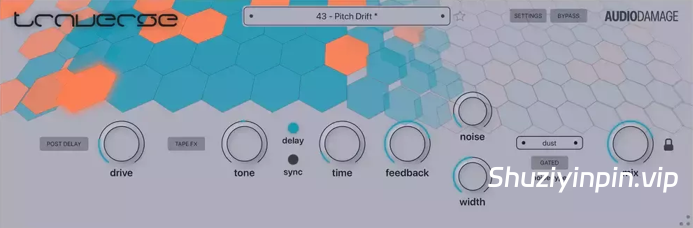
Traverse 是一款集低保真磁带效果和立体声延迟于一体的插件。磁带部分运行一个基于磁滞模型的磁带引擎,带有驱动、抖晃、颤动以及倾斜均衡音调控制。延迟部分则具备延迟效果器的基本功能——时间、反馈、宽度、同步和乒乓延迟。后置延迟路由切换开关允许您交换两者的顺序,因此您可以将其用作磁带风格的延迟效果器,或内置延迟的磁带效果器。
此外,它还包含一个用于程序化音频中断的四控制拼接系统,以及一个具有九种风格的程序化噪声生成器——嘶嘶声、噼啪声、灰尘声、风扇隆隆声、60Hz 嗡嗡声、50Hz 嗡嗡声、白噪声、粉红噪声和 Califone 读卡器噪声。噪声会路由到磁带路径,因此您在输出过程中设置的其他参数都会影响噪声的最终效果。
这是我们动态效果系列的第三款产品,前两款分别是 Ascent 和 Descent。和我们其他产品一样:支持 Mac、Windows、Linux 和 iOS 系统。无 DRM、无订阅、无加密狗,永久授权。
使用体验……
鼓组总线显然是最佳目标——只需几圈“驱动”和一些“哇音”,就能将一套干净的鼓组音色变成老旧的、音质损失严重的 dub 版本。人声效果也很好,尤其是在提高本底噪声的情况下;“嗡嗡声”和“嘶嘶声”可以让你获得类似 AM 收音机的房间氛围,而无需录制任何内容。我们通常将其用于合成器音垫,并提高拼接率,同时开启“读卡器噪声”音色,营造设备故障的效果。如果你将其连接到单个吉他和弦上并按下“反馈”按钮,循环就会自饱和,形成一个你可以驾驭的持续音。最后一个是我们最喜欢的。
功能特性:
采用磁滞磁带模型的卡带引擎——在预加重和去加重滤波器之间封装了状态相关的非线性磁滞方程,并在饱和器阶段进行过采样。呃……听起来像卡座。内部增益补偿使输出电平在整个驱动扫描范围内保持一致。
驱动– 从干净的新磁带状态扫描到完全驱动,去除氧化铁。滞后曲线会响应信号历史,这使其区别于静态饱和曲线。
抖晃和颤动– 两个独立的深度旋钮,分别用于控制卡带的慢速音调漂移(抖晃)和快速调制抖动(颤动),每个旋钮都由各自的低频振荡器驱动,并叠加噪声成分。每个声道的调制赋予立体声图像一种自然的卡带抖动。
音调– 位于卡带信号流中的双极性倾斜均衡器。左声道较暗,右声道较亮,中心平坦。一个旋钮即可实现高低频搁架式均衡。
反馈回路中的磁带模拟器– 每次重复都会经过驱动、音调、抖晃和颤动的重新处理。推高反馈,重复会逐渐变成自饱和的混响;拉低反馈,则会产生两到三种不同颜色的回声。
时间– 立体声延迟时间在自由模式下为 20 毫秒至 10 秒,启用同步后,延迟时间将与宿主速度的节拍划分(直拍、三连音、1/32 拍到两个全音符)同步。
反馈– 循环量,有上限限制,即使将驱动设置为最大值,循环也不会失控。
宽度– 连续乒乓控制。正值会将第一个回声发送到右侧并交叉馈送通道。
拼接系统– 程序化磁带拼接模拟器,带有四个交互控件。时间设置事件速率(事件之间 0.5 秒到 1 分钟不等,旋钮行程集中在关键的快速端)。深度设置深度。音高和幅度切换每次中断的音高啁啾和幅度下降分量,因此您可以调节出从干净的磁带到磨损的磁带的任何效果。
精选噪声生成器– 九种程序化噪声:嘶嘶声、噼啪声、灰尘声、风扇隆隆声、60Hz 嗡嗡声、50Hz 嗡嗡声、白噪声、粉红噪声和 Califone 读卡器声。选择一种噪声,设置其强度,噪声将直接输入到磁带路径中,并在每次重复播放时像输入信号一样进行塑形。门
限噪声– 启用后,当输入静音时,噪声基底将比“噪声”设置低 20 dB,因此房间音仅在音轨播放时出现,并在乐句之间消失。
延迟后路由切换– 关闭(默认)为 Space-Echo 模型:磁带优先,延迟次之,反馈通过整个磁带链返回。启用后,顺序反转,磁带仅处理延迟尾音,使 Traverse 成为具有更传统磁带风格的延迟效果器,并具有干净的输入路径。
混合– 标准干/湿混合,默认为全湿,因此插件从加载之初就表现为效果器。
无咔嗒声旁路– 平滑的 50 毫秒交叉淡入淡出,适用于实时 A/B 对比和现场演出。
Traverse is a lo-fi tape effect and stereo delay in one plugin. The cassette side runs a hysteresis-modeled tape engine with Drive, Wow, Flutter, and a tilt-EQ Tone control. The delay side does what delays do — Time, Feedback, Width, sync, ping-pong. A Post-Delay routing toggle lets you swap their order, so you can use it as either a tape-flavored delay or a cassette effect with a delay built in.
Layered on top: a four-control splice system for procedural dropouts, and a procedural noise generator with nine styles — Hiss, Crackle, Dust, Fan Rumble, 60Hz Hum, 50Hz Hum, White, Pink, and the Califone Card Reader. The noise routes into the cassette path, so whatever else you’ve dialed in shapes it on the way out.
This is the third entry in our Motion Effects family, alongside Ascent and Descent. Same as the rest of our catalog: Mac, Windows, Linux, and iOS. No DRM, no subscriptions, no dongles, perpetual license.
In Use…
Drum buses are the obvious target — a couple turns of Drive and some Wow take a clean kit and age it down to a generation-loss dub. Vocals respond well too, with the noise floor up; the Hum and Hiss voices give you AM-radio room tone without having to record anything. We tend to use it on pads more than anything, with the splice rate up and the Card Reader noise voice running, for the broken-equipment thing. And if you park it across a single guitar chord and push Feedback, the loop self-saturates into a drone you can ride. That last one is our favorite.
Features
Cassette engine with magnetic-hysteresis tape model – State-dependent nonlinearity hysteresis equations wrapped between pre-emphasis and de-emphasis filters, with oversampling at the saturator stage. Errr. In English, sounds like a cassette deck. Internal gain compensation keeps output level consistent across the full Drive sweep.
Drive – Sweeps from clean new tape to fully driven, shedding iron oxide. The hysteresis curve responds to signal history, which is what separates this from a static saturation curve.
Wow and Flutter – Two independent depth knobs for the cassette’s slow pitch drift (Wow) and faster modulation jitter (Flutter), each driven by its own LFO with a noise component layered in. Per-channel modulation gives the stereo image a natural cassette wobble.
Tone – Bipolar tilt EQ sitting inside the cassette signal flow. Darker to the left, brighter to the right, flat at center. One knob does the work of separate high and low shelves.
Tape emulator inside the feedback loop – Every repeat is re-processed through Drive, Tone, Wow, and Flutter. Push Feedback and the repeats bloom into a self-saturating wash; pull it back for two or three colored echoes.
Time – Stereo delay time from 20 ms to 10 seconds in free mode, or snapped to host-tempo beat divisions (straight and triplet, 1/32 through two whole notes) when Sync is engaged.
Feedback – Recirculation amount, ceiling-limited so the loop cannot run away even with Drive at maximum.
Width – Continuous ping-pong control. Positive values send the first echo to the right and cross-feed the channels.
Splice system – Procedural tape splice simulator with four interacting controls. Time sets event rate (0.5 seconds to one minute between events, knob travel packed at the fast end where it matters). Depth sets the amount. Pitch and Amp toggle the pitch-chirp and amplitude-dip components of each dropout, so you can dial in anything from a clean spool to a worn-out shoebox tape.
Curated noise generator – Nine procedural noise voices: Hiss, Crackle, Dust, Fan Rumble, 60Hz Hum, 50Hz Hum, White, Pink, and the Califone Card Reader. Pick a voice, set the amount, and the noise feeds straight into the cassette path where it gets shaped on every repeat just like the input signal does.
Gated noise – When on, the noise floor drops 20 dB below the Noise setting whenever the input is silent, so the room tone speaks only when the track does and disappears between phrases.
Post-delay routing toggle – Off (default) is the Space-Echo model: cassette first, delay second, with feedback returning through the full cassette chain. On flips the order so the cassette processes the delay tail only, turning Traverse into a more conventional tape-flavored delay with a clean input path.
Mix – Standard dry / wet blend, defaulting to fully wet so the plugin reads as an effect from the moment it loads.
Click-free Bypass – Smoothed 50 ms crossfade for live A/B comparisons and live performance use.
![[Cradle插件系列集合] Cradle Everything Bundle 13 OCT 2026 [WiN]](https://www.shuziyinpin.vip/wp-content/uploads/2026/10/Cradle-Everything-Bundle-13-OCT-2026.png)
![[零延迟调音台风格通道条] Lemur Audio SAMUEL v1.0.21 Incl Patched and Keygen-R2R [WiN]](https://www.shuziyinpin.vip/wp-content/uploads/2026/10/lemur-audio-samue-1.png)
![[高频空气感增强插件] Bogren Digital A-Class v1.0.1 [WiN, MacOSX]](https://www.shuziyinpin.vip/wp-content/uploads/2026/10/bogren-digital-a-class.png)
![[16 款 Safari 插件全新升级包] Safari Audio Safari Pedals Everything V2 v2026.10.10 Incl Keygen-R2R [WiN]](https://www.shuziyinpin.vip/wp-content/uploads/2026/10/Safari-Pedals-Everything-V2-300x280.png)
![[完整版:最好的合成器之一] Native Instruments Absynth v6.2.0-bobdule [WiN]](https://www.shuziyinpin.vip/wp-content/uploads/2026/10/Absynth-v6.2.0.png)
![[节奏工作站+原厂音色+46个扩展] Native Instruments Maschine 3 v3.7.1-bobdule [WiN]](https://www.shuziyinpin.vip/wp-content/uploads/2024/11/353c92b1a12aaa28a86c088231eb7f4c-1024x649.jpeg)

评论0